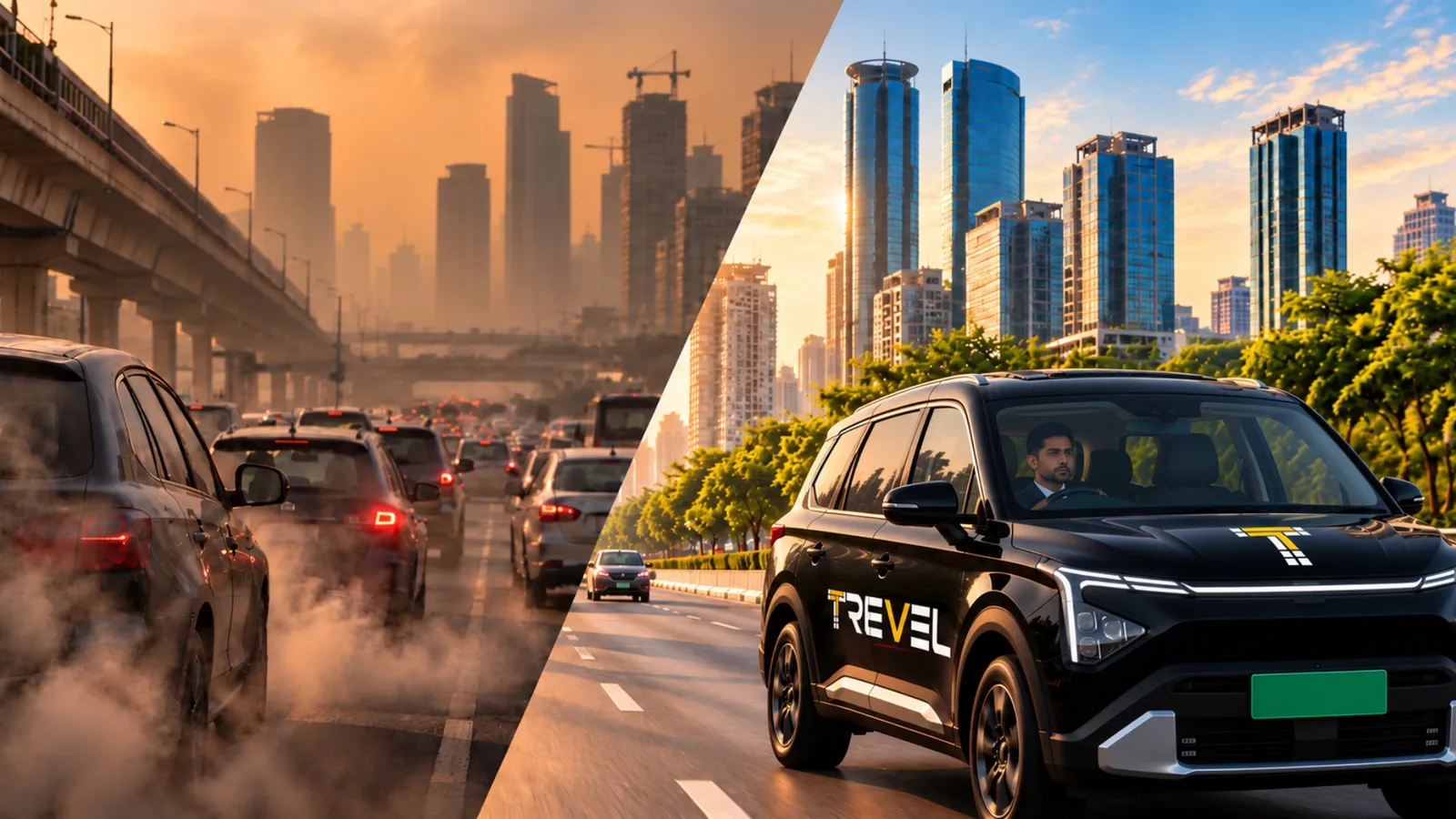
Gurgaon now offers a choice that many Indian cities are still getting used to: you can book a fully electric cab for your daily commute, airport transfer, or evening out. The question riders keep asking is a fair one—is an EV cab actually better, or is it simply a newer, greener-looking version of the same thing?
We’ve heard from riders across Cyber City, DLF, Golf Course Road, and Sohna Road about their experiences. Here’s what people who have used both types of cabs have to say—and where the differences really matter.
First, the Big Shift: What Gurgaon Riders Are Telling Us
Gurgaon faces significant air-quality challenges, particularly during the winter months, when pollution levels can rise sharply. Road transport contributes to particulate pollution in Delhi NCR, although its contribution varies by location, season, and the methods used to measure emissions. Research on Delhi, for example, has found that local road transport contributes around 10% of daily mean PM2.5, rising to approximately 17% when regional road transport emissions are included. These figures are specific to the study’s location and period, rather than a universal estimate for Gurgaon.
EV cabs are becoming an alternative to conventional petrol-powered cabs. Riders who use them often highlight one thing above everything else: the experience feels different in ways they may not have expected.
“I booked it thinking it would be the same as any other cab. But when I got in, there was no smell, no vibration, no noise. I actually finished a client call on the way to the airport—something I’d never managed in a regular cab.” — Abhishek M., Business Head, Gurgaon
1. The Ride Experience: Noise, Smell and Comfort
This is where the difference can be most immediately noticeable to riders.

Petrol Cab
Petrol engines produce background noise—a low rumble that you may stop consciously noticing but that remains present during calls, conversations, and quiet moments. Depending on the vehicle’s condition and ventilation system, outside traffic fumes and engine vibrations may also affect the ride experience.
Drivers who spend 8–10 hours behind the wheel may also experience fatigue. Noise, long working hours, and exposure to traffic pollution can all affect driver comfort and well-being.
EV Cab
The absence of conventional engine noise changes the character of the ride. EV cabins can be quiet enough for normal-volume conversations, clear phone notifications, and a chance to unwind after a long workday.
Trevel lists vehicles such as the MG Windsor, Kia Carens Clavis EV, and BYD e6/eMax 7 in its fleet. These vehicles offer electric driving, with cabin space and seating comfort varying by model.
Electric vehicles also do not have conventional gear shifts or clutch engagement. Their smooth, responsive acceleration can make stop-and-go traffic in Gurgaon more comfortable, particularly during longer commutes.
2. Air Quality Inside the Cab
This is a factor many riders may not think to ask about, but it matters, especially in Gurgaon.

In petrol cabs, outside pollution can enter the passenger compartment through the ventilation system. The extent depends on factors such as the vehicle’s air filtration system, its maintenance, ventilation settings, and surrounding traffic conditions.
EV cabs produce no tailpipe emissions, which means they do not directly release exhaust gases while driving or idling. However, this does not mean that the air inside an EV is automatically free of pollution. Cabin air quality still depends on filtration, ventilation, and outside conditions. Electricity generation can also produce emissions, depending on the energy sources used.
For riders with allergies or asthma, or those who simply want a more comfortable journey through congested traffic, these factors are worth considering.
3. Cost: Is an EV Cab More Expensive?
This is the most common concern, and the short answer is that it depends on whom you book with and what you’re comparing.
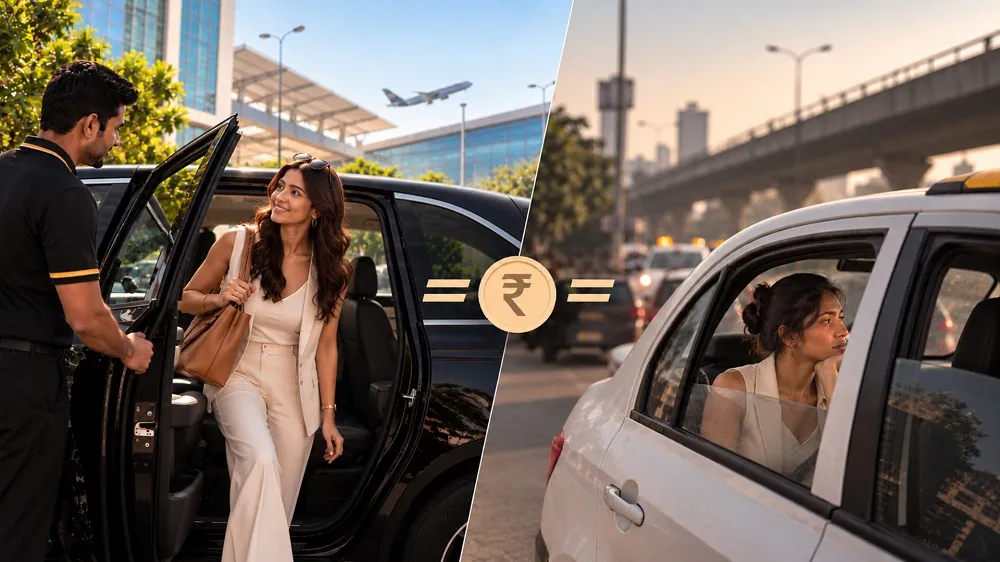
EV cabs on aggregator platforms such as Ola or Uber, when available, may be priced comparably to their petrol-powered counterparts. However, fares vary by route, demand, vehicle category, time of day, and availability, so a fixed price difference cannot be assumed.
The difference in price is not necessarily about the fuel. It may also reflect the vehicle category, booking model, and level of service offered.
Premium EV cab services that offer pre-booking, fixed fares, and professional chauffeurs position themselves as premium products. Their pricing may be comparable to higher-tier offerings such as Ola Prime or Uber Premier rather than entry-level categories. You may be paying for a confirmed vehicle, a professional chauffeur, and predictable pricing where fixed fares are offered.
Important: The cheapest cab may not always be the most suitable option for a time-sensitive journey. Consider potential waiting times, cancellations, and uncertainty when comparing prices, particularly for airport transfers and important meetings.
4. Environmental Impact: Numbers That Deserve Attention
Gurgaon and the wider Delhi NCR region face recurring air-pollution challenges, particularly during winter. Road transport is one of several contributors to particulate pollution, alongside sources such as industry, power generation, domestic activities, and regional pollution.
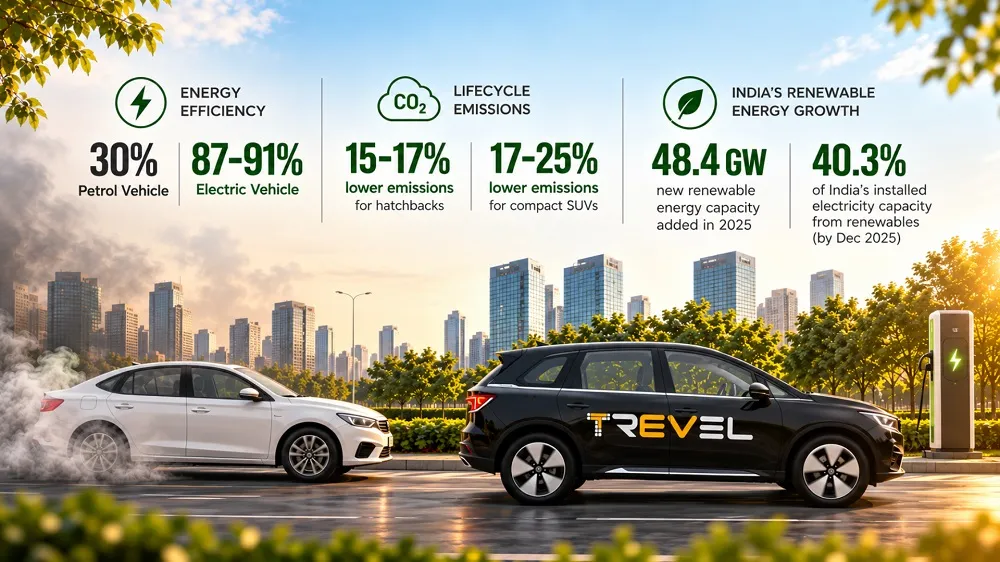
Here is what research tells us about EVs compared with petrol vehicles.
- Energy efficiency: A typical EV is estimated to be 87–91% efficient, compared with about 30% for a conventional petrol vehicle, according to the US Department of Energy. These figures use a specific energy-efficiency methodology and should not be interpreted as a direct comparison of running costs or total lifecycle emissions.
- Lifecycle greenhouse gas emissions: The overall advantage depends on the vehicle, battery production, lifetime distance travelled, and the electricity used for charging. An India-focused study published in 2025 estimated that battery electric vehicles could produce around 15–17% fewer lifecycle greenhouse gas emissions than comparable internal-combustion vehicles in the hatchback category and 17–25% fewer in the compact SUV category, based on India’s 2023 electricity mix. These estimates should not be generalised to every EV or driving scenario.
- India’s energy transition: India added approximately 48.4 GW of renewable energy capacity during 2025, including around 37.9 GW of solar and 6.3 GW of wind capacity. By December 2025, wind, solar, and other renewable sources accounted for approximately 40.3% of India’s installed electricity-generation capacity. Installed capacity is not the same as the share of electricity actually generated, but continued renewable-energy expansion can help reduce the emissions associated with EV charging over time.
Choosing an EV cab is not a grand gesture. It is a small, consistent decision that, when repeated across thousands of daily rides, can contribute to reducing tailpipe emissions in the city. The overall climate benefit depends on the electricity supply and the vehicle’s lifecycle emissions.
5. Driver Quality and Professionalism
This is an indirect benefit of the EV cab model that many people may not consider. EV cab services that invest in premium vehicles may also invest in driver selection and training. This can be partly an economic consideration—the cost of operating a premium electric vehicle differs from that of a conventional sedan—and partly a matter of market positioning.
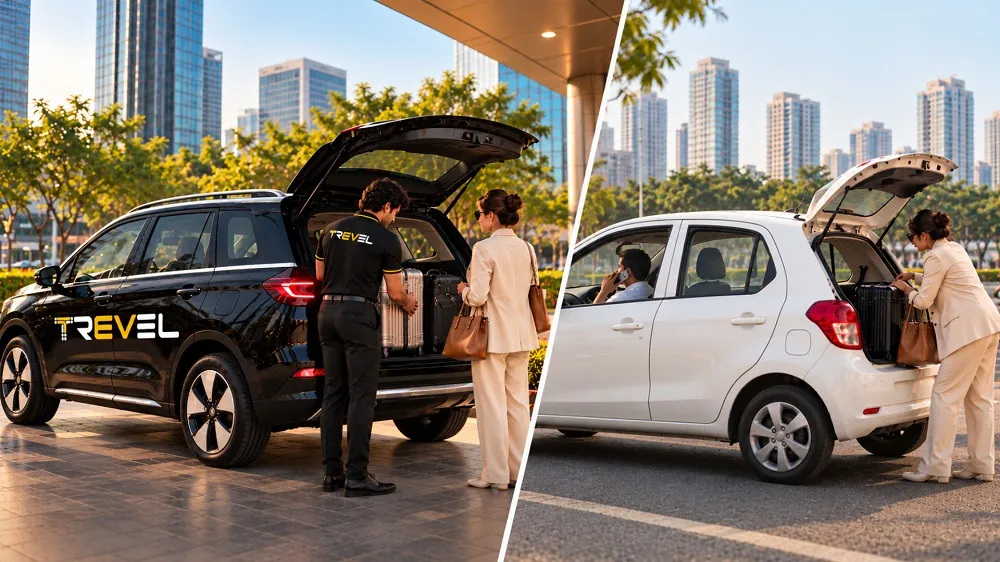
Trevel states that its drivers work fixed shifts to help prevent fatigue. Its website also describes its chauffeurs as background-verified and professionally trained.
Driver fatigue is an important road-safety concern, and measures that limit excessive working hours can help address it. However, the quality of a ride ultimately depends on the individual driver, the operator’s policies, vehicle maintenance, and how consistently those standards are followed.
Background-verified, professionally trained drivers in well-maintained premium vehicles are a key part of the service proposition for premium cab providers. Riders should compare the actual safety and service features offered rather than assume that every EV cab service follows the same standards.
6. Reliability: Cancellations and No-Shows
Ask any frequent Gurgaon commuter about their worst cab experience, and cancellations may come up quickly. Last-minute cancellations on app-based platforms can leave passengers stranded, particularly when a driver declines a trip or cannot complete a booking.
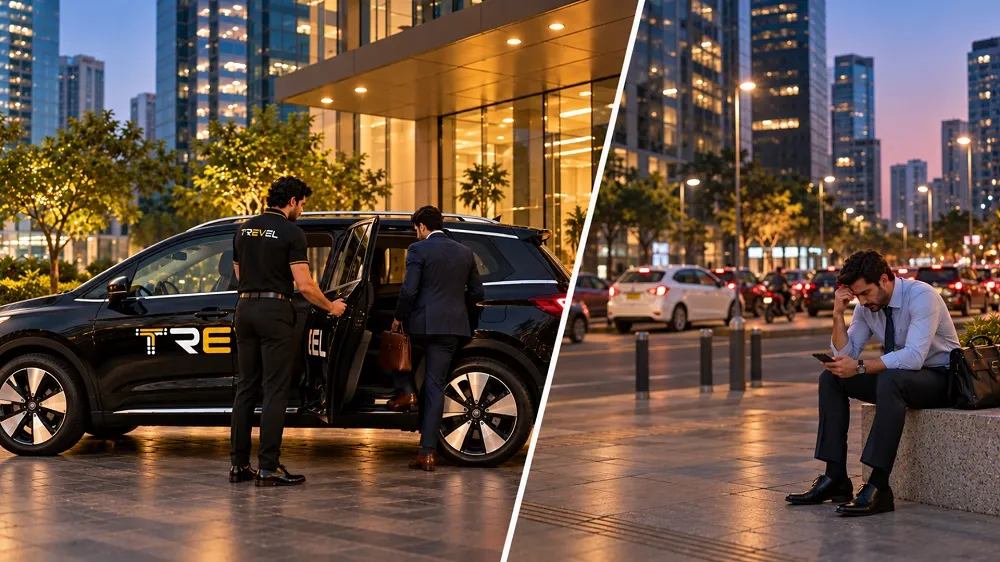
EV cab services built around pre-booking can help reduce this uncertainty by assigning a driver in advance. When you book a Trevel ride, the company says that your chauffeur is assigned ahead of time and reports to your pickup point before the scheduled time. Trevel also advertises a zero-cancellation commitment.
Advance allocation and clear booking commitments can improve predictability, but riders should still check the provider’s booking confirmation, cancellation terms, and customer-support arrangements before relying on any service for a time-critical journey.
So, Which Should You Book?
It depends on your journey.
- For short daily trips where cost is the primary consideration: Compare the available fares, waiting times, and vehicle options. Any suitable cab that meets your needs and budget may be appropriate.
- For airport transfers, important meetings, or other time-sensitive journeys: A pre-booked EV cab service with confirmed vehicle allocation and transparent pricing may justify the premium.
- For women travelling alone, late-night rides, or longer commutes: Look for background-verified drivers, in-vehicle safety features such as AI-enabled dashcams where available, and clear customer-support arrangements. These features depend on the service provider and should not be assumed to be available on every booking.
- For consistent quality over time: If comfort, quieter journeys, and advance booking are priorities, an EV cab may be a good fit for regular travel, provided it is available and suits your budget.
Gurgaon is part of a wider shift in how people travel around Indian cities. The EV cab is not just a vehicle with no tailpipe emissions; it can also offer a quieter, smoother ride and a different approach to urban mobility. The best choice depends on your priorities, the service provider, and the journey you need to make.
 Book My Ride Now